

Fix Army Performance Evaluations
Introduction
When the Department of Government Efficiency (DOGE) was proposed, I was somewhat optimistic that the bureaucracy that makes the Army challenging could be fixed. In fact, I was hopeful that DOGE would set up a portal—like Denver Water [1] uses for neighbors to snitch on each other when overwatering in a drought—where we could all identify waste within our organization and processes.
Although DOGE didn’t ask me, I have still thought about how the Army could save time and money through small and simple solutions. Using the lenses of behavioral economics and systems engineering, I outline some key problems with the Evaluation Entry System (EES) and propose low-cost fixes that would dramatically cut down on time spent processing Officer Evaulation Reports (OERs) and Noncomissioned Officer Evaluation Reports (NCOERs) across the force while also improving the usefulness of these career-defining documents in talent management.
Behavioral Economics
The Army’s (Noncommissioned) Officer evaluation reports (NCOERs/OERs) are annual evaluations that suck the life out of everyone involved. The Evaluation Entry System (EES) portal, where evaluations are submitted digitally, is run by Human Resources Command (HRC) and can be equally frustrating. Behavioral economics has a term for this: sludge.
While not quite the same, as sludge is intentional friction to shape choices, the unintentional friction is a massive drain on personnel already in a resource-constrained environment. [2]
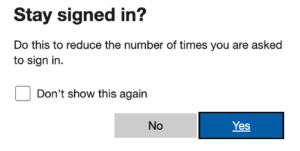
A prime example is Windows asking you to stay signed in when logging on with your CAC (spoiler alert: it doesn’t change a thing).
A Systems Engineering Approach
This is, in fact, one of the core principles to lean systems—going to the gemba. The gemba is a Japanese term in lean manufacturing for “the real place.” In other words, go to where the problem is occurring. While a consultant might help a company save money through cuts and process improvement, they are outsiders looking for places to implement new solutions; it takes time to identify the pain points. It is much more efficient to start with those doing the work on the “shop floor” and ask what needs fixing. The employees will enthusiastically respond with the problems they experience daily and what a potential solution would look like to them.
Leaders maintaining a “[g]emba attitude means that you make every decision based on the principle that real improvement only takes place through a shop-floor focus based on direct observation. So if you don’t spend enough hours yourself on the shop floor you can’t understand the important details, and won’t be able to challenge the people to come up with better solutions. Even managers must understand the need to prioritize investment in direct supervision.” [3]
Another key perspective to keep in mind is the principles of cost savings and cost avoidance.
Suggestions
Here is my attempt at highlighting some of the easy processes to fix:
No formal training in evals (hit-or-miss on whether your Rater knows what to do)
The Army consistently has an on-the-job training mindset. A Soldier’s evaluation is the most important document in their career when it comes to boarding for promotions and new jobs, and we let supervisors just wing it. Now, we have gen.ai to help write evaluations, but in an age where artificial intelligence will be utilized more and more, how are Soldiers to distinguish themselves if leaders are all outsourcing their evaluations to the same tool?
The best help I have received was from my Company Commander as a Platoon Leader, showing me in regulation where to find different aspects of an evaluation. I also utilize Effective Phrases for Performance Appraisals by James E. Neal, Jr. to help articulate aspects of performance in my evaluations. While artificial intelligence can certainly help generate ideas, this does not negate the need for leaders to hone their writing skills.
Allow leaders to write about poor performance
Netflix is a company known for its aggressive emphasis on establishing the right culture through hiring, retaining, and often firing talent. “The Keeper Test is a measure used by managers at Netflix to regularly reassess every employee on their teams. If a person said they were leaving for another job, you ask yourself if you would fight to keep them. If you wouldn’t, you should consider firing them.” [4]
I am often unnecessarily constrained to either write less and hide performance in ambiguity or the white space (what I don’t say speaks volumes), or I have to have an extensive paper trail to prove that you have been counseling that Soldier. Instead, I would like to identify shortcomings the rated Soldier needs to work on over the next rated period. If I am handing that Soldier off to a new unit or Rater, that allows them to further develop the rated Soldier, starting with an initial counseling.
Don’t let us sign in the wrong order
Although I am not a software engineer, I imagine it is very simple to build in logic-based protections against signing an (NC)OER in the wrong order. The amount of evals I have had to fix due to the wrong order it was signed in is ridiculous.
Fix AFT section
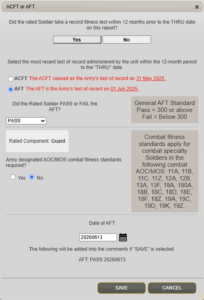
This is the lowest-hanging fruit. We are two physical fitness tests behind in a digital (adaptable?) system.
Connect to IPPS-A and populate whether a Soldier is promotable
Everyone likes to check the box that they are promotable. There are very few instances where this is true. Connect to IPPS-A, and evals won’t get rejected for the Soldier selecting this incorrectly.
Standardize how OERs and NCOERs are formatted
Ditch the typewriter-era formatting for NCOERs, and standardize Company-grade evaluations for OERs and NCOERs. The fields are already the same, and by aligning formatting styles, it cuts down on administrative overhead. Speaking of which, no one knows how to use a semicolon, so don’t incentivize it in NCOERs. I will also settle for eliminating fake bullet points with a lowercase “o” instead of just using “•” or “-” or complete sentences.
Remove broadening assignments for WOs
The point of a Warrant Officer is to specialize. Remove the box to input broadening assignments on their evaluation; it’s not their role.
Pre-populate duty position based on MTOE
The Army allows the Soldier to populate their own duty position and description. As an organization, we should do a better job of defining what it is, say, an Aviation Platoon Leader’s role is and what that job description is like. I’ve had to scour ATP 3-04.23 Army Aviation Platoons and TC 7-22.7 The Noncommissioned Officer Guide to find and make up a basic description. If everything’s connected to IPPS-A, pre-populate these and allow the SM to tailor as they see fit.
Immediately notify you when you need a reviewer based on ranks
Regulation stipulates when a supplemental reviewer is required. EES lets you figure that out yourself after HRC kicks it back. Certain ranks in certain positions should trigger a notice that a supplemental reviewer is required instead of giving the Rater a box to check whether it’s required or not.
Clear signatures button
When HRC kicks back an eval for corrections, the Rater should have an “erase all signatures” button. It’s already rejected and needs correction. Half the time, I spend waiting for the Rated Soldier and Senior Rater to unsign an eval when the correction will take 5 minutes tops.
Rating scheme as a downloadable Excel template to then upload regularly
Everyone has their own style of documenting things, and the rating scheme in EES is a prime example of poor user interface necessitating external solutions. I have my master Command spreadsheet to track all of my personnel data. It’s accessible to those within my Command team as well as the PLs and PSGs. The problem with the rating scheme is that it’s so slow, you can’t brainstorm in the system itself, and you dread updating it.
If EES offered an Excel template to download, populate, and upload, that would eliminate a lot of the tediousness and enable us to conform to the Army system of choice.
Auto-save and stop timing out so quickly
Government websites are notorious for kicking you off if you haven’t been active, but our profession also relies on adaptability and accessibility to leaders. Furthermore, our digital world is full of distractions, and I can’t restart an evaluation if I have to quickly respond to an email. Just add an auto-save function, please.
OER Support Form is superfluous
I appreciate the idea here is to set goals and hold yourself accountable, but everyone ends up drafting their own eval anyways. The OER support form is unnecessary and poorly executed. Goal-setting already happens in initial and quarterly counselings. Adding the goals to a support form that doesn’t transfer into the evaluation itself is unnecessary
If you don’t exit out, it locks the form
If someone opens an evaluation to action it, closing the tab or exiting the website doesn’t unlock the eval for everyone else again. I have had to ask Soldiers to open EES and click the exit button on an eval so I can action it as they requested. More waste.
Allow us more delegates
Delegates are a hidden gem of EES, but it restricts how many you can have in each function. I would like to open that up. As a Company Commander, I’d love for my PSGs, 1SG, the S-1 NCOIC, and the CSM to be able to view and action NCOERs in my queue. If those within the rating scheme have view/edit/submit access, it would streamline the eval process.
Summary
I summarized 15 relatively simple solutions to very time-consuming problems faced by most Army Soldiers. This may not be as glamorous as a new weapon system or uniform, but removing the sludge improves morale, frees up time, and allows Soldiers to do their jobs instead of the burnout of bureaucracy.
As Eric Ries points out in his book, The Lean Startup, “There is a reason that all past management revolutions have been led by engineers…: management is human systems engineering.” [5] The beauty of the Army National Guard is the varied backgrounds Soldiers bring to their military roles. The Army can and should make use of the talent they already have to minimize waste and streamline processes within the force. Eliminating waste will dramatically improve morale, retention, and lethality.
Acknowledgements
Thank you to MAJ Brandon Lee and SFC Steven Matkovich for reading and providing feedback.
Sources
[1] Denver Water’s Use Only What You Need portal
[2] Sludge by Dan Pilat and Dr. Sekoul Krastev (2021)
[3] The Gold Mine by Freddy Ballé and Michael Ballé
[4] The Keeper Test: How Netflix Decides to Fire Someone by Rina Shah (2021)
[5] The Lean Startup by Eric Ries